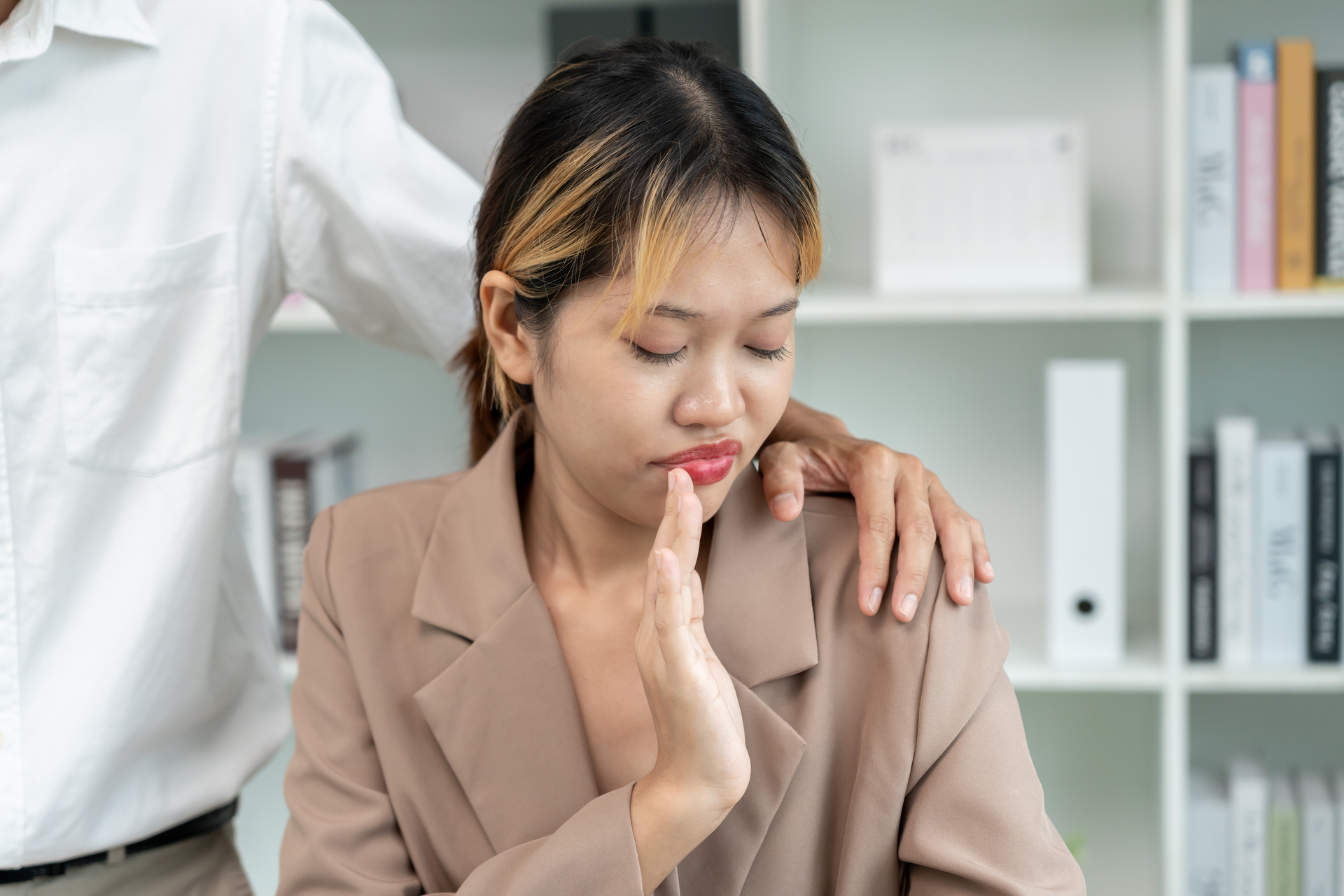

Workplace Discrimination
New York City Sexual Harassment Lawyers
Too often, employees endure unlawful conduct because they fear industry blacklisting, retaliation, or skepticism. If you are experiencing unwanted sexual advances, inappropriate commentary, coercion, or abuse disguised as "office culture," you have the law firmly on your side!
At Filippatos PLLC, our New York City employment discrimination lawyers are here for you.
914-984-1111

We understand the professional, psychological, and financial fallout of workplace misconduct, and we have a proven track record of taking on some of the world’s largest corporations and media conglomerates.
NYC Has the Strongest Sexual Harassment Protections in America
Employees in New York City are protected by three overlapping tiers of anti-discrimination statutes:
- federal law (Title VII of the Civil Rights Act of 1964)
- state law (the New York State Human Rights Law)
- municipal law (the New York City Human Rights Law).
For decades, federal courts applying Title VII dismissed credible harassment claims under the demanding “severe or pervasive” standard. Under this doctrine, workers were frequently forced to prove an ongoing, egregious pattern of abuse before a court would recognize an actionable violation.
New York City deliberately broke away from this standard, creating the most worker-protective harassment laws in the nation.
The Federal Standard
Title VII applies to employers with 15 or more employees, including labor and employment agencies. Unwelcome sexual advances, requests for favors, and other verbal or physical conduct constitute harassment when this conduct explicitly affects an individual’s environment or interferes with their livelihood.
The law distinguishes two main types of harassment within Title VII: quid pro quo and hostile work environment. The former is characterized by a supervisor conditioning job benefits, raises, promotions, and other features on submission to unwelcome advances. The latter is defined as any jokes, slurs, or physical conduct that are sufficient to alter the conditions of employment and create an intimidating environment.
The harasser can be anyone with the agency or organization; it does not have to be someone of the opposite sex of the person experiencing assault, whether it be a supervisor, a co-worker, a non-employee, or otherwise.
The NYCHRL “Treated Less Well” Standard
Under the New York City Human Rights Law (N.Y.C. Admin. Code § 8-107), plaintiffs are not required to prove that harassment was “severe or pervasive.” Instead, an employee only needs to demonstrate that they were “treated less well than other employees” because of their gender, sex, sexual orientation, or gender identity.
The sole defense available to an employer under city law is to prove that the conduct amounted to nothing more than “petty slights or trivial inconveniences”—a defense evaluated through the lens of a reasonable person in the victim’s position, not through an executive’s subjective opinion.
The 2019 NYSHRL Amendments
Following major legislative reforms that took effect in 2019, the New York State Human Rights Law (N.Y. Exec. Law § 296) eliminated the outdated “severe or pervasive” standard statewide. The state statute now mirrors the city’s standard, requiring an employee to demonstrate only that they were subjected to inferior terms, conditions, or privileges of employment because of their protected characteristics.
Furthermore, New York State eliminated the historic Faragher-Ellerth affirmative defense under state law. Previously, an employer could escape liability if an employee did not utilize internal human resources reporting procedures. Today, in New York, an employee’s decision not to file an internal HR complaint does not bar their claim.
Zero-Employee Threshold and Broad Worker Coverage
- No Minimum Size Requirement: Unlike federal law (which applies only to employers with 15 or more employees), the NYCHRL protects workers against sexual harassment at companies of any size, including firms with just one employee.
- Expanded Protection for Non-Employees: Under N.Y. Exec. Law § 296-d and the NYCHRL, legal protections against sexual harassment explicitly extend beyond W-2 employees to include independent contractors, freelancers, subcontractors, consultants, interns (paid or unpaid), and temporary staff.
- Mandatory Annual Training: Under the Stop Sexual Harassment in NYC Act of 2018, all private employers in New York City with 15 or more workers must provide interactive, comprehensive anti-sexual harassment training annually to all employees, reinforcing that the prevention of misconduct is an institutional legal duty.
What Counts as Sexual Harassment?
Workplace sexual harassment takes many forms. It involves overt physical aggression; more often, it manifests as subtle boundary violations, implied conditions for professional advancement, or a pervasive environment that undermines a worker’s performance.
Under both city and state law, sexual harassment falls into distinct categories:
Quid Pro Quo Sexual Harassment
Quid pro quo harassment occurs when employment terms, conditions, or opportunities are conditioned—explicitly or implicitly—on an employee’s submission to unwelcome sexual advances or conduct.
Common examples include:
- Conditioning a promotion, bonus, desirable account, or performance review on romantic compliance.
- Threatening termination, demotion, salary reductions, or poor performance evaluations if romantic advances are rejected.
- Altering an employee’s work schedule, shift assignments, or remote privileges after an advance is rebuffed.
Under New York state law, a single instance of quid pro quo harassment is sufficient to establish an employer’s strict liability.
Hostile Work Environment
A hostile work environment exists when unwelcome discriminatory conduct, remarks, or dynamics alter the conditions of employment, resulting in an environment where an employee is treated less well because of their sex, gender, pregnancy, or sexual orientation.
A hostile work environment can be created by supervisors, peers, subordinates, or even third parties (such as clients, vendors, or independent contractors) if the employer knew or should have known about the conduct and failed to take immediate corrective action.
Establishing a hostile work environment includes:
- Unwelcome sexual comments, propositions, or persistent romantic overtures.
- Graphic discussions of personal sexual activities, vulgar jokes, or derogatory gender-based comments.
- Inappropriate, non-consensual physical contact, deliberate crowding, or physical intimidation.
- The display, circulation, or electronic transmission of sexually suggestive images, memes, emails, or text messages.
- Gender-based hostility, policing of gender roles, or derogatory remarks directed at pregnant or postpartum employees, consistent with the EEOC’s 2024 Harassment Enforcement Guidance. (This Guide has been rescinded as of January 1st, 2026, but the information is still available.)
Harassment of Remote and Gig Workers
Modern employment does not stop at the door. The widespread shift to hybrid schedules and the expansion of the gig economy have shifted where harassment occurs, but not its illegality.
Our firm actively represents remote workers facing online harassment, as well as freelancers and independent contractors who are targeted by clients or management.
Unlawful virtual harassment includes:
- Inappropriate comments made via internal messaging platforms like Slack, Microsoft Teams, Zoom, or Google Meet.
- Pressuring remote employees to turn on cameras during private hours or making unsolicited remarks regarding an employee’s attire, physical appearance, or living space.
- Late-night calls, text messages, or direct messages on personal social media channels from managers or colleagues that blur professional boundaries.
- Threatening to withhold gig-worker invoice approvals, platform access, or renewal contracts unless an individual tolerates inappropriate sexualized interactions.
You Cannot Be Silenced: NDA’s and Mandatory Arbitration Limits
Historically, corporations and institutional offenders weaponized forced arbitration clauses and non-disclosure agreements to bury sexual harassment claims out of public view.
Today, state and federal law severely limit the ability of employers to silence survivors.
The Federal Ending Forced Arbitration of Sexual Assault and Sexual Harassment Act (EFAA)
Enacted in 2022, the federal EFAA (9 U.S.C. §§ 401–402) invalidated mandatory pre-dispute arbitration agreements and pre-dispute joint-action waivers for sexual assault and sexual harassment disputes.
If you signed an arbitration clause as part of an onboarding packet, offer letter, or employment contract:
- You retain the right to take your sexual harassment claim to open court.
- Your employer cannot force you into private, confidential arbitration where corporate misdeeds remain hidden.
- You hold the absolute option to litigate before a jury or choose alternative dispute resolution on your own terms.
New York Restrictions on Non-Disclosure Agreements
Under New York law, (N.Y. C.P.L.R. § 5003-b), an employer cannot force a victim of discrimination or harassment to enter into an NDA that prevents the disclosure of the underlying facts of the claim, unless:
- Confidentiality is the employee’s explicit preference;
- The employee is given 21 days to consider the non-disclosure provision; and
- The employee is provided a mandatory 7-day revocation period after signing.
Moreover, no non-disclosure or non-disparagement agreement can legally prevent you from reporting harassment, speaking with law enforcement, cooperating with an administrative agency (such as the EEOC, the New York State Division of Human Rights, or the NYC Commission on Human Rights), or testifying under subpoena.
High-Profile Results, Handled Discreetly
Taking legal action against an employer requires courage, especially when opposing prominent corporate entities, major institutions, or well-connected executives. You need an advocate who has proven they cannot be intimidated.
Filippatos PLLC is known for handling marquee, high-stakes litigation against institutional powerhouses.
Our firm served as counsel in the nationally covered Grossberg v. Fox News case, holding one of the world’s most visible media conglomerates accountable for a pervasive, toxic work environment and retaliatory conduct. Our matters have been reported across national and international press, including The New York Times, The Washington Post, The Wall Street Journal, Los Angeles Times, and CNN.
Confidentiality by Design
While our attorneys have the resources and courtroom experience to try claims in public, the vast majority of our clients prefer a resolution without headlines. We routinely resolve complex sexual harassment and retaliation matters through private, highly favorable pre-litigation negotiations, protecting our clients’ reputations and preserving their career trajectories without ever filing a public complaint.
Whether your strategy calls for discreet pre-suit negotiation or assertive public litigation, we anchor our approach in institutional leverage and meticulous factual preparation.
Explore our past matters and settlements on our case results page.
Compensation in NYC Sexual Harassment Cases
The NYCHRL is widely considered the most remedial anti-discrimination statute in the United States. In a sexual harassment action under city and state law, victims are entitled to pursue several forms of recovery:
- Back Pay: Compensation for past wages, unpaid bonuses, equity vesting, commissions, health insurance benefits, and retirement contributions lost due to unlawful termination, constructive discharge, or demotion.
- Front Pay: Monetary compensation for future earnings lost if an employee is forced out of an industry or cannot quickly secure comparable employment.
- Emotional Distress Damages: Financial recovery for psychological trauma, stress, anxiety, depression, loss of enjoyment of life, and physical symptoms caused by workplace abuse. Notably, New York courts do not require extensive psychiatric medical treatment to award emotional distress damages.
- Punitive Damages: Available under both the NYCHRL and NYSHRL against employers and individual perpetrators who act with malice, reckless indifference, or willful disregard for an employee’s protected civil rights.
- Attorneys’ Fees and Costs: Prevailing plaintiffs can recover reasonable attorneys’ fees and litigation expenses, preventing employers from using prolonged litigation to exhaust an employee’s resources.
Learn more about potential recovery in our comprehensive guide to damages and compensation in workplace discrimination cases.
Deadlines to File a Sexual Harassment Claim in New York
The statutes of limitations for sexual harassment claims in New York City are among the most generous in the country, but waiting too long can permanently forfeit your right to recover.
- NYC Commission on Human Rights (NYCCHR): Employees have 3 years from the date of the last gender-based harassment incident to file an administrative complaint under the Stop Sexual Harassment in NYC Act.
- New York State Human Rights Law (NYSHRL): Under state law, an employee has 3 years to file a complaint of sexual harassment directly with the New York State Division of Human Rights (NYSDHR) or file an action in New York State Supreme Court.
- Federal Equal Employment Opportunity Commission (EEOC): Under Title VII, an administrative charge must be filed within 300 days of the discriminatory act in New York (because New York has state and local anti-discrimination agencies).
If your harassment claim involves unlawful retaliation—such as being fired or demoted for reporting misconduct—similar critical deadlines apply. If you have been penalized for speaking out, review our workplace retaliation guide to understand your legal options.
Frequently Asked Questions About NYC Workplace Sexual Harassment
Can I file a claim if my employer has fewer than 15 employees?
Yes. Under the New York City Human Rights Law (NYCHRL), anti-harassment protections apply to all employers, regardless of headcount. Under New York State law, the minimum employer-size threshold for sexual harassment has also been removed. Even if you work for a sole practitioner, a startup, or a boutique firm with only one or two employees, you are fully protected.
What if I did not report the harassment to HR before quitting?
Under the NYSHRL and NYCHRL, your failure to use internal employer grievance procedures does not bar your legal claim. While reporting can be helpful evidence, New York law recognizes that internal HR departments often serve company interests rather than victim safety. You may still file an administrative charge or lawsuit regardless of whether you notified HR.
What is constructive discharge?
Constructive discharge occurs when an employer deliberately creates or knowingly permits workplace conditions so intolerable, abusive, or hostile that a reasonable person in the employee’s position would feel compelled to resign. Under the law, a constructive discharge is treated the same as an involuntary, wrongful termination.
Can an individual harasser be held personally liable in New York?
Yes. Unlike federal law (Title VII), which holds only corporate entities liable, both the NYCHRL and NYSHRL allow individual supervisors, managers, and co-workers to be named as defendants if they directly engaged in, aided, or abetted the discriminatory conduct.
What should I do if my employer retaliates against me for reporting harassment?
Retaliation is strictly illegal under federal, state, and city laws. Employers are prohibited from firing, demoting, ostracizing, reducing pay, changing shift assignments, or taking any other adverse action against any worker who reports harassment in good faith or participates in an investigation. In many cases, a retaliation claim succeeds even if the underlying harassment claim is ultimately dismissed.
Speak with a New York City Sexual Harassment Attorney Today
If you are experiencing sexual harassment, gender discrimination, or retaliatory treatment in your workplace, you do not have to confront corporate defense counsel or internal HR alone.
Contact Filippatos PLLC today for an objective, completely confidential case assessment. We will analyze the facts, explain your statutory rights, and formulate a clear strategy to hold wrongdoers accountable while protecting your career.
Related Blogs